

Octo Green 12
price per kwh
13.5
¢
at 1,000kWh
monthly
$135/mo.
Avg. Bill
PECO dates back to 1899 when 18 electric companies merged to form the Philadelphia Electric Company. In the 20th Century, PECO expanded its operations throughout the city of Philadelphia and into the surrounding counties. Then in 1996 to comply with Pennsylvania deregulation, PECO sold off its generation divisions to focus on delivering energy to its nearly 2 million customers in in the greater Philadelphia area, becomingthe largest electric and natural gas utility in PA. As part of Exelon, PECO delivers energy and aids organizations that support education, the environment, arts and culture, and neighborhood development programs.
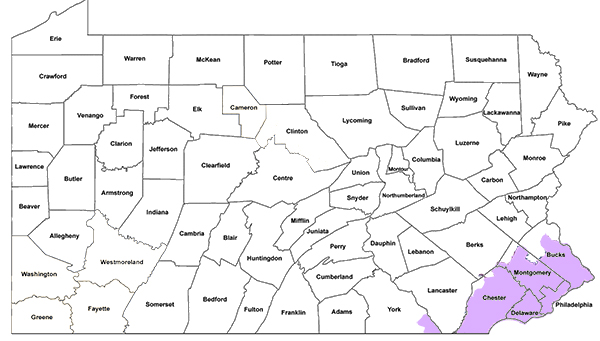
PECO serves approximately 1.6 million electric customers and more than 511,000 natural gas customers in the City of Philadelphia and some or all of these southeast Pennsylvania counties:
| Bucks | Chester | Delaware | Montgomery | York |
| City of Philadelphia | Chester | Doylestown | Media | Norristown |
Starting a service with PECO is easy and convenient. Just visit the PECO web site to start, stop, or move electric and/or gas service.
Customers can also set up service by calling PECO customer serivce (1-800-494-4000).
All electric service connections and disconnections are processed starting at 8 AM and are performed remotely.
Be ready to supply:
All Pennsylvania electric utilities can charge a deposit based on a customer's credit worthiness. The amount cannot be greater than two months of estimated usage. Customers have 21 days after the utility sends the deposit request notification to make a payment. However, customers have three months to pay the full deposit.
PECO will do a soft credit check to determine if you will need to pay a deposit.
Tip -- Don't forget to unfreeze your credit! If any major credit agencies hold a frozen credit account for you, they need to be temporarily unfrozen before you submit your service request.
If based on your credit history, PECO determines that a security deposit is necessary, they will notify you in writing within 3 business days. They'll also include the specific reason why they're requesting a deposit.
Not all customers must pay a security deposit, and in some instances, the security deposit may be waived.
Customers can contact PECO customer service at 1-800-494-4000 or via the PECO Customer Service webpage.
When Pennsylvania deregulated its energy market in 1997, customers were allowed to shop around for their electricity supplier, rather than be bound to the local utility rate. Under PA deregulation, utility companies like PECO Power that wanted to participate in the consumer choice market were obliged to sell off their generators, becoming distribution companies instead.
To protect energy customers from service disruptions the PA PUC requires PA utilities to provide electricity supply at a default rate without mark up to customers who choose not to shop for a retail supplier.
These utility default rates are also called the "Price to Compare" or PTC. These default rates are overseen and must be approved by the PA PUC.
The primary difference between PECO and an electricity supplier is that PECO owns and maintains the distribution network in its service area. This includes all of substations, poles, lines, and meters that bring electricity to your home.
Customers should contact PECO when they have a problem with their billing or cannot pay the amount due according to their monthly statement. In case of an emergency or outage, Customers should also contact PECO at 1-800-841-4141 or through their current electric outages webpage.
Lastly, PECO is the "last resort" supplier if your supplier stops serving customers in PA. This way, your electricity service will not be interrupted if your supplier leaves the state.
Pennsylvania residential customers now pay separate charges for the cost to deliver their electricity and for the amount of electricity supply that they use.
Because PECO owns and maintains the distribution network, all electricity customers must pay a fixed distribution charge (sometimes called a "tariff"). This way, all PECO customers pay the same distribution rate (depending on their service class) no matter which supplier they have.
Utility distribution rates are overseen by the PA PUC and can periodically change. Assuming an average usage of 864 kWh per month, the PECO distribution portion of a monthly bill could look like this:
| Rate of $0.06609 per kWh | Monthly Customer Charge | Total | |
| Monthly Distribution Charges (excluding riders) | $57.10 for 864 kWh Used | $9.98 | $67.08 |
The supply charge is the amount you pay for the electricity that you actually use. PECO customers may choose the "Price to Compare" (PTC) for their electricity supply. However, PA consumers can also choose to buy electricity from competitive retail electricity suppliers.
Retail electricity suppliers purchase energy from generator companies on the wholesale markets. They then sell this power to their customers to use. Rates vary between competing retail suppliers and this acts as an incentive for companies to keep their prices as low as possible. Customers can switch to a new retail supplier at any time but may incur an early termination fee if they break a contract with a retailer.
The Price to Compare is the price the utility pays generator companies for electricity. It includes the price to generate the electricity, as well as the cost to transmit it over high voltage transmission power lines to PECO's local electrical switch yards. From there, the electricity is distributed throughout the PECO grid and delivered to businesses and homes.
Currently, twice-a-year auctions are held to cover four delivery periods. As a result, PECO's PTC rates change every March 1, June 1, September 1, and December 1. When the auctions are completed, the PAPUC must approve the prices for both the generation supply and transmission.
For customers, PECO's PTC rates change every three months. That means the PTC electricity rates fluctuate throughout the year and can vary with the seasons; low some months, and higher during others.
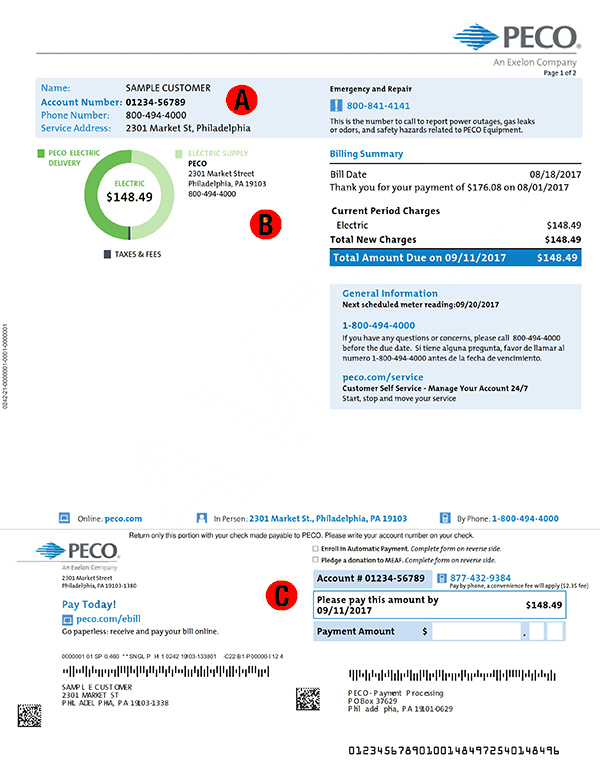
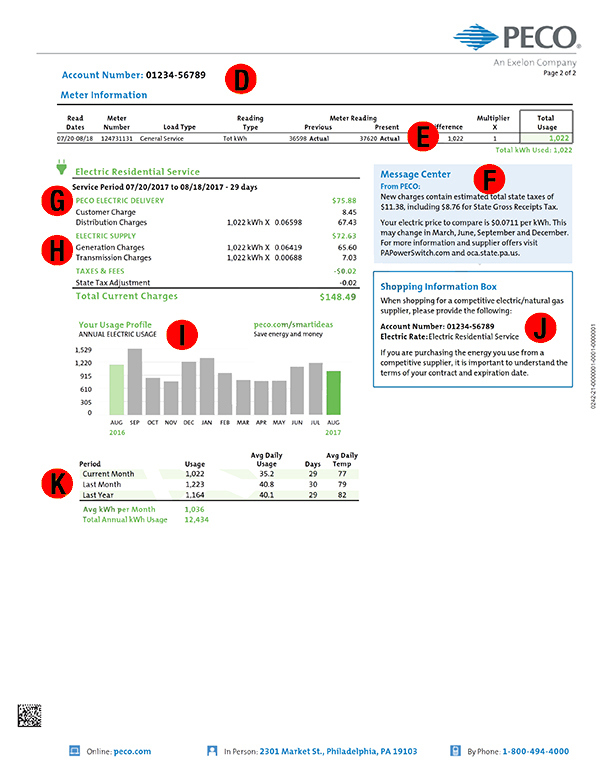
Your PECO bill includes a substantial amount of information that may be confusing to customers. But understanding your bill can give you great insight into your usage and rates. To help you better understand, we break down the most important bill items below.
As your local electric utility, PECO offers several rebate and energy efficiency programs to help customers reduce their monthly bill by upgrading their home's energy performance. Some programs also offer money-saving incentives while others could make paying your monthly bills much easier during those expensive winter months.
| Program Name | Program Type | Benefit |
| Appliance and HVAC Rebates Program | Energy Efficiency Rebate Program | PECO customers working with a participating Electrical Association of Philadelphia (EAP) HVAC contractor can take advantage of rebates on the purchase of ENERGY STAR certified water heaters, washers, dryers, refrigerators, freezers, ventilation fans, and dehumidifiers. Rebates range from $25 to $400. |
| LED Instant Rebate Program | Energy Efficiency Rebate Program | PECO residential customers can get instant rebates on LEDs by shopping the online PECO Marketplace or in the lighting aisle at Philadelphia area stores. |
| Energy Efficient New Homes | Energy Efficiency Rebate Program | PECO is working with area builders who are constructing energy-efficient homes that are 15% to 50% more energy efficient than other new homes. PECO New Homes Program can qualify new construction for special Energy Efficient Mortgages. |
| Residential In-Home Energy Assessment | Energy Efficiency Rebate Program |
PECO's low-cost Home Energy Assessment Program will inspect your home for energy efficiency improvement and:
|
| Low Income Usage Reduction Program | Residential Energy Efficiency | Provides a free energy audit to PECO customers using more than 600 kWh per month to find ways to reduce their electric bills with weatherization and conservation. |
| PECO Payment Arrangements | Bill payment assistance | PECO offers payment arrangements to allow residential customers to pay their account balance in monthly installments based on the amount of the balance, income, household size, and your history with prior payment arrangements. Contact customer service or sign up online. |
| PECO Gift of Energy | Bill payment assistance | Give a gift to a friend or family member by making a payment their PECO bill. |
| LIHEAP Cash and Crisis Grants | Bill payment assistance | LIHEAP available from early November through early April. The program is available to eligible customers whose income is 150% of the Federal Poverty Level or below. |
| Matching Energy Assistance Fund (MEAF) | Bill payment assistance | PECO matches customer donations to the MEAF fund to provide help to limited-income households. The maximum grant amount is $500 but must bring the past due balance to zero. |
| Customer Assistance & Referral Evaluation Service (CARES) program | Bill payment assistance | You may qualify for CARES if you are experiencing a temporary hardship and want to work with a CARES representative. Call PECO Universal Services at 1-800-774-7040. |
| PECO Customer Assistance Program (CAP) | Bill payment assistance |
PECO's Customer Assistance Program (CAP) can give you a monthly credit on your PECO bill. The credit is based on your household's gross income and energy use. To apply, customers will need to supply the following information:
You must use PECO for your electric and natural gas supply to qualify. You cannot be enrolled with a competitive supplier. |
Unlike PECO, retail electricity suppliers in PA shop for bargains and set up deal on the wholesale electricity market. So their rates are not dictated by Pennsylvania Public Utility Commission (PA PUC) the same way that PECO and other local utilities are. This gives PA shoppers access to a number of different rates, plan lengths, and plan types.
While PECO's PTC rates change every 3 months, the PTC provides a useful baseline figure when you shop electric rates. This makes it a useful tool for comparing the value of short term and long term retail supplier plans.
When you're shopping for retail suppliers, you can choose variable rate plan or a fixed rate. Both types of plans have their pros and cons. That's why it's essential to carefully consider which type of electricity plan is right for you.
Electricity retailers offer a wide range of different plans to suit different customers. Some suppliers offer plans with renewable energy sources or other greener options such as investing back into solar or wind energy. Additionally, keep an eye out for any kind of perks or deals you may be able to take advantage of. Some retailers may offer reimbursement in the form of gift cards, discounts, or specialty pricing if conditions are met.
If your fixed rate plan has expired and you're shopping again, don't expect to find the same rate! Remember that the PECO PTC rate changes 3 times per year. And while energy prices change all the time, rates tend to dip during the fall and spring. Those months are typically the best time to shop the best rates.
When you're comparing retailer rates to PTC rates, you need to keep more in mind than just the price. The best way for a PA energy customer to avoid making a bad choice is to ask the right questions. When you shop electricity suppliers, always be sure to ask these important questions:
Decide what to shop for first, Pennsylvania natural gas or Pennsylvania electricity.
Simply enter your zipcode, and select your local utility to find the latest plans and rates for your area.
Browse from among the best plans and energy providers in the PECO region.
Don't have it handy? - Don't worry!
According to the Pennsylvania Public Utility Commission, on average, customers who switch to a competitive supplier can expect to save about 10% to 15% compared to the price-to-compare.
 Shop For The Lowest PECO Utility Rates: