Compare the Best Energy Rates
Find the lowest rates.
Select a Service Type and Enter Your ZIP Code to Get Started

Rated 5/5
Based on over 41,000 reviews
40%
Save up to 40%

100+
Electricity Providers

40+
Natural Gas Providers
Automatic Savings
Trusted by 10,000+ Customers
Same Power. Same Utility. Just 5-20% Less
money_bag 5-20% Less
Automatic monthly bill savings
verified_user Zero Risk
$0 cost to sign up. Cancel anytime.
solar_power No Installation
No panels. No equipment. No changes.
apartment Renters Welcome
Available to apartments & non-homeowner
Save up to 20%
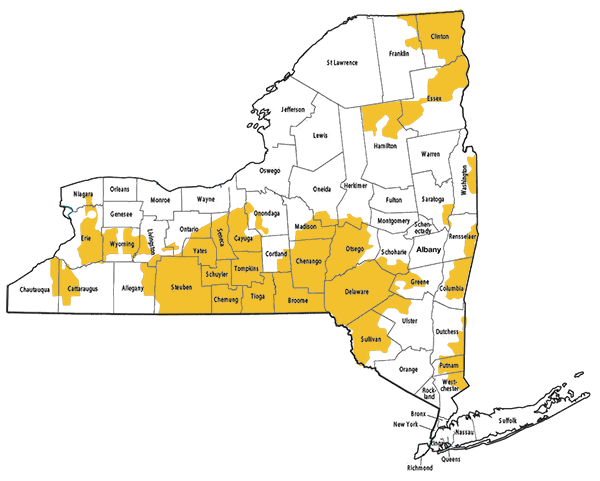
Check AvailabilityNYSEG Service Area Map
NYSEG serves approximately serves 268,806 natural gas and 902,593 electricity customers in some or all of these New York Counties:
Cities Served By NYSEG
Auburn, Binghamton, Geneva, Ithaca and Plattsburgh
What Are NYSEG PTC Charges?
When deregulation began in New York, all utilities that wanted to participate in consumer choice had to sell off their generators and limit their business to energy delivery. However, the NY PSC requires these utilities to provide electricity supply at a default rate to customers in their service territory who don't shop for a retail supplier. As a result, these utilities must purchase their electricity supply for the default rate from generator companies.
The NY PSC oversees NYSEG's default service rates since these represent generation supply costs that are passed directly through the utility onto their customers without mark up. This default rate is also called the "Price to Compare" or PTC.
Price to Compare (PTC)
The PTC default rate represents the actual price (generation + transmission) the utility pays for the electricity. In other words, it not only includes the generator company's price for making the electricity but also the cost to transmit it from power stations over high tension power lines to NYSEG's local electrical switch yards. From there, the electricity is distributed throughout the NYSEG local electrical grid for delivery to homes.
NYSEG's PTC rate is composed of the Supply charge. This rate is based upon market conditions during the billing period and will vary depending on where you live or do business. The NYSEG supply charge varies based on forecasted daily market prices. Consequently, the PTC monthly bill rates changes monthly. There are also other charges which include the Merchant Function Charge, the Clean Energy Standard Supply Surcharge, the Electricity Supply Reconciliation Mechanism, and other surcharges that add to the cost.
Because electricity demand fluctuates due to seasonal weather, NYSEG's Supply charge rates can also vary seasonally; low some months, higher the next -- especially in summer when air conditioning usage can soar. With the default PTC rate, you can never be too sure what you'll pay from one month to the next.
NYSEG Current PTC Standard Residential Rates:
- 12.410 cents per kWh in NYSEG West Zone, expires
- 12.410 cents per kWh in NYSEG East Zone, expires
- 12.410 cents per kWh in NYSEG Lower Hudson Valley Zone, expires
How to Start New NYSEG Service
Getting set up with NYSEG is easy and convenient. Just visit the NYSEG web site to start your electric service. If you don't have an account, you can start one there and then follow the prompts to set up your service.
Customers can also apply to start service by calling NYSEG customer service (1-800-572-1111 ).
Be ready to supply:
- Service Address: The address where you want your service turned on or switched.
- The start date for electricity service.
- Personal Information: You will need to provide a valid form of identification (such as a driver's license or credit card) to validate your name and prior address. Otherwise, you will need to pay a deposit.
- The utility may also require proof of your occupancy date for service and ask you for a copy of your lease or deed.
Applicants for electric service must have paid in full all bills on their past NYSEG accounts or agree to a deferred-payment plan before a new account can be opened. NYSEG will notify you by letter within three business days after receiving your application if it has been denied. The letter will state the reason(s) for denial, exactly what you must do to be approved.
Will I Need to Pay a Deposit to Start NYSEG Service?
In New York, no utility can require any new residential customer to pay a security deposit as a condition of receiving utility service. The same applies to anyone over 62 year old. Lastly, if you receive public assistance, you will not need to pay a deposit.
However, the utility can require a deposit if:
- You're new seasonal or short-term customer.
- You are applying for a new NYSEG account within 60 days of closing an old account and the bill you get once every two months is 50 days overdue, and you have not paid at least one-half of what you owe.
- You were previously disconnected during the past six months.
Note: If you're aged 62 or older or you are receiving public assistance, supplemental security income, or additional state payments then you will not need to pay a deposit.
If you must pay a deposit -- NYSEG must notify you in writing within 3 business days about the specific reasons why you are required to pay a security deposit. NY law states that deposits cannot be greater than an estimated two months usage.
Customers have 20 days after the utilty sends the deposity request notification to make a payment. However, customers can pay the full deposit in installments over a 12 month period. NYSEG can hold deposits for residential service for 12 months. If the customer pays their bill in full and on time for 12 consecutive months, the deposit will earn interest.
Understand Your NYSEG Bill
The typical NYSEG bill is about 5 pages long and contains many details that can be confusing to customers. However, there's lots of useful information to help you better understand your usage and what actually goes into your NYSEG rates. Below, we summarize the most important items you need to understand on a sample NYSEG Electric bill.
NYSEG Sample Bill
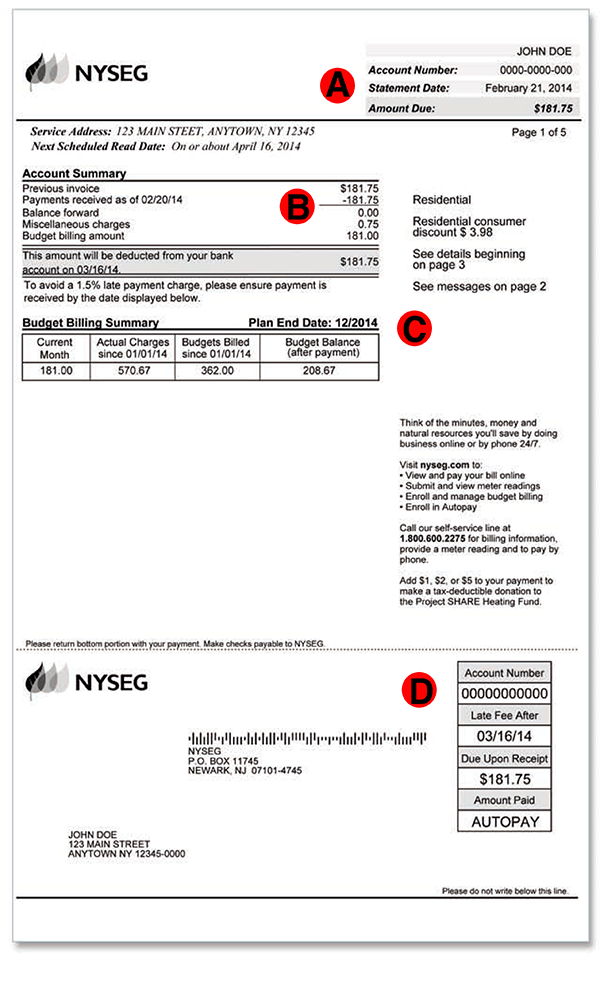
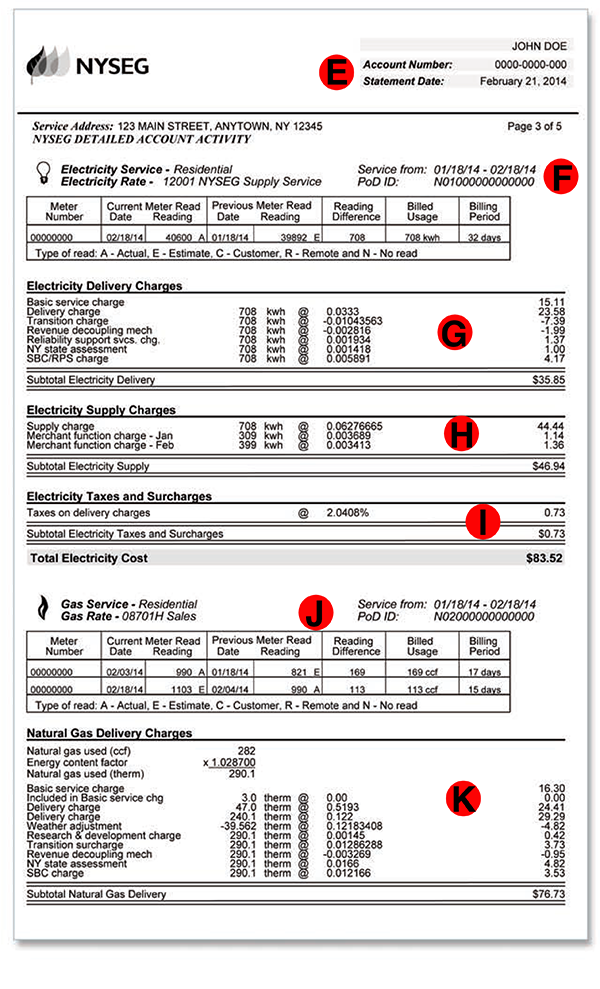
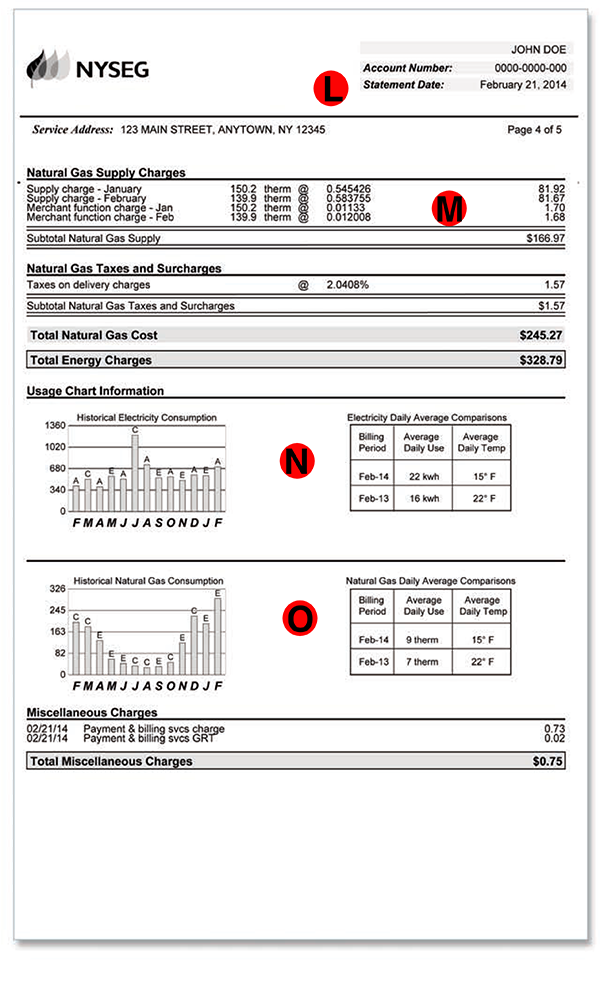
- A: Name, Account Number, Statement Date. This section shows your name, 11 digit NYSEG account number, the statement date, and the amount due.
- B: Account Summary. This section shows your previous charges, previous payment, any balance forwarded, and your current charges for NYSEG.
- C: Budget Billing Summary. Customers who enroll in Budget Billing can see a breakdown of their current balance for the year. Customers in the Budget Billing program pay the same amount for 11 months of the year.
- D: Pay Stub. This section This section shows the service address and the mailing addres to return this stub with your payment if you pay NYSEG by mail. To the right, it displays your customer account number and summarizes the total amount due for the current billing period. It also shows the date that late charges will take effect if the bill has not been paid by then.
- E: Page 3, Name, Account Number, Statement Date. This inform is show at the top of each bill page to help keep your bill organized. This page covers the details of your monthly usage. Electricity sections are marked by a light bulk icon, natural gas by a flame icon.
- F: Electricity Service and Account Activity. This section shows your service type and service rate (NYSEG residential rates are indicated by the "12001" code). This section also shows the service dates (usually 30 days). It also shows your Point of Delivery or POD number. You need to tell a retailer this number when you shop for an electricity supplier. The next section shows your meter information, including the current reading, the previous reading, dates, and the kWh amounts used.
- G: Electricity Delivery Charges. Here you can see how NYSEG's delivery charges breakdown. They include the customer charge, the delivery charge per kWh used, the transisiton charge, and other fees and rider surcharges approved by the New York PSC.
- H: Electricity Supply Charges. This section details the cost for NYSEG's PTC electricity. However, customers who have shopped and signed with an ESCO for their electricity will see that supply information here, instead.
- I: Electricity Taxes and Surcharges. This section shows taxes and any additional surcharges for your electricity.
- J: Natural Gas Service and Account Activity. Much like deregulated electricity, NYSEG also delivers natural gas and offers default supply service for natural gas. Likewise, customers can also shop for an alternative natural gas supplier. Usage amounts are in hundred cubic feet (ccf).
- K: Natural Gas Delivery Charges. This section displays the delivery charges per hundred cubic feet (ccf) used.
- L: Page 5, Name, Account Number, Statement Date. This page provides useful information on your annual and currently monthly gas and electricity usage charges.
- M: Natural Gas Supply Charges. This section details the cost for NYSEG's PTC natural gas rate. However, customers who have shopped and signed with an alternative gas supplier will see that supply price and usage breakdown here, instead.
- N: Electricity Usage Chart. Here you can find your electricty usage rate for the past 12 months. You can also
- O: Natural Gas Usage Chart. This section displays your natural gas usage for the past 12 months. Likewise, you compare the past month's consumption th the same period as last year.
Ready to choose your energy rate?
Enter your ZIP code to explore the best energy plans in your area. Compare energy rates side by side, and choose the one that fits your home and budget.