


Rated 5/5
Based on over 41,000 reviews
40%
Save up to 40%

100+
Electricity Providers

40+
Natural Gas Providers
Recommended ComEd Electricity Plans in ~market_label~
Commonwealth Edison Service Territory

ComEd serves these cities:
| Aurora | Chicago | Joliet | Naperville | Rockford |

ComEd Electricity Rate Price Alert!
The lowest Electricity rate in the service area is 10.100¢ per kwh. That is 2.8% lower than ComEd's Price to Compare of 10.39¢ per kwh.
Compare The Best ComEd Electricity Rates
We've researched the best providers and plans so you can find a great electricity rate in Illinois
Sample Rates Showing for Chicago Illinois
| Company | Term | Rate |
|---|---|---|
| American Power & Gas | 1/months | 7.49¢/kWh |
| NRG Home | 3/months | 10.10¢/kWh |
| Constellation | 12/months | 11.39¢/kWh |
| XOOM Energy | 12/months | 11.69¢/kWh |
| Think Energy | 12/months | 11.80¢/kWh |
| Santanna Energy Services | 12/months | 12.32¢/kWh |
| Spark Energy | 12/months | 12.79¢/kWh |
Enrolling in Community Solar in Illinois
Community solar in Illinois offers residents an accessible way to support renewable energy without installing panels on their property. To get started, visit utilityrates.com to compare available community solar projects across the state. Three notable projects include the Prairie State Solar Garden in Carbondale, the Midwest Renewable Energy Park in Grundy County, and the ComEd Community Solar initiative in northern Illinois.
Enrollment Steps:
- Check your utility service area eligibility on utilityrates.com
- Review available community solar subscriptions near your location
- Determine the percentage of your electricity you want to offset
- Complete the online subscription application with your chosen project
- Verify billing credits will be applied to your existing utility account
Most community solar programs in Illinois allow residents to subscribe to a portion of a solar array, receiving credits on their utility bill proportional to their share of energy produced. Typical subscriptions range from 10-100% of a household's average electricity consumption.
For the most up-to-date information, always consult utilityrates.com for current community solar options in Illinois.
What Are Commonwealth Edison PTC Charges?
When deregulation began in Illinois, all utilities that wanted to participate in consumer choice had to sell off their generators and limit their business to energy delivery. However, the Illinois Commerce Commission requires these utilities to provide electricity supply at a default rate to customers in their service territory who don't shop for an alternate retail electricity supplier. As a result, these utilities must purchase their electricity supply for the default rate from generator companies.
The Illinois Power Agency (IPA) oversees Commonwealth Edison's default service rates. These rates represent the generation supply costs that are passed directly through the utility onto their customers without mark up. This default rate is also called the "Price to Compare" or PTC.
Price to Compare (PTC)
The PTC default rate represents the actual price (generation + transmission) the utility pays for the electricity. In other words, it not only includes the generator company's price for making the electricity but also the cost to transmit it from power stations over high tension power lines to Commonwealth Edison's local electrical switch yards. From there, the electricity is distributed throughout the Commonwealth Edison local electrical grid for delivery to homes.
The IPA administers a competitive bidding process each year to line up supply from generators for ComEd and other utilities in Illinois. Electricity supply rates are based upon market conditions during the billing period and will vary depending on where you live or do business. The Commonwealth Edison supply charge varies based on forecasted daily market prices. Consequently, the PTC electricity rates change on average every three to five months.
The PTC rate also includes ComEd's Purchased Electricity Adjustment ("PEA"). The PEA is a charge or credit on your bill to ensure that ComEd customers do not pay 0.5 cents/kWh more or less than ComEd's actual cost of purchased electricity. The PEA is calculated each month and so affects your bill differently each month.
Because electricity demand fluctuates due to seasonal weather, Commonwealth Edison's Supply charge rates can also vary seasonally; low some months, higher the next -- especially in summer when air conditioning usage can soar. With the default PTC rate, you can never be too sure what you'll pay from one month to the next.
Commonwealth Edison Current PTC Standard Residential Rates:
10.390 cents per kWh in Commonwealth Edison, expiresBill Questions? Electricity Out? Contact Commonwealth Edison!
Having problems or interruptions with your Commonwealth Edison electricity? Here's the proper people to call.
ComEd Billing Problems
First thing to do is contact Commonwealth Edison Customer Service at 1-800-EDISON-1 (1-800-334-7661) and learn what options you have. If you are having trouble paying your monthly bill then call Commonwealth Edison's Bill Payment Center:1-888-315-1755. Have your account number ready. You can also apply for payment methods online through your Commonwealth Edison account.
Consider Budget Billing: If you are constantly blind-sided by seasonally high bills, check out budget billing. This payment plan averages out your electricity costs over the cost of the year. This ensures that customers aren't presented with unexpectedly high bills at peak times.
ComEd Emergencies and Outages
All power lines are extremely dangerous! Never attempt to move a downed power line by yourself. Call 911 and then notifiy Commonwealth Edison.
- Report downed powerlines and other safety hazards immediately to Commonwealth Edison at 1-800-334-7661.
- You can also report downed lines or outages at Commonwealth Edison's website.
- Check Commonwealth Edison's current electric outages as they are being repaired.
How to read your ComEd Bill
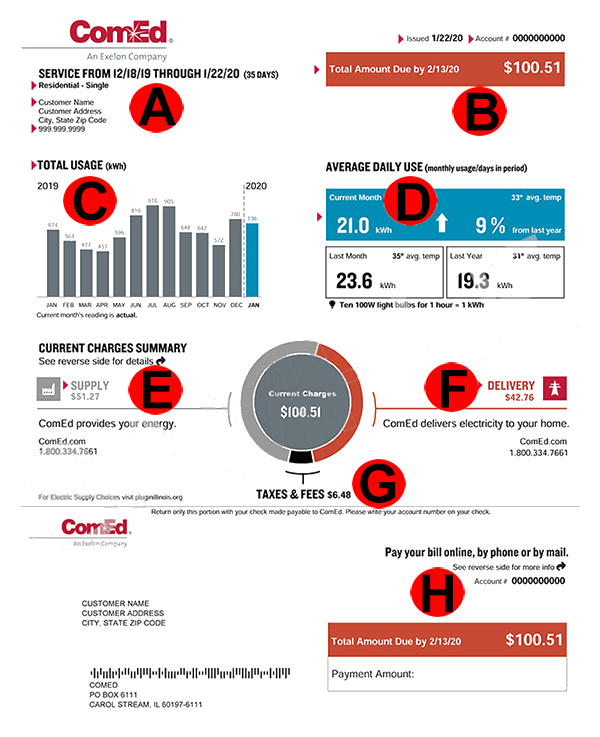

- A: Service Summary This section shows the service date period, the service type, your name, address and phone number.
- B: Service Summary. This section shows your your current charges for Commonwealth Edison, the date the bill was issued and your 10 digit account number.
- C: Yearly Usage Summary. Here you can see a breakdown of your current month's usage and how it compare for the past 12 month period.
- D: Daily Usage Summary. This section shows your current month usage, the aveerage monthly temperature, and how it compares to your previous month's usage.
- E: Current Charges Summary. Here you can see a how much your energy supply this month cost you, whether it's from ComEd or your retail provider.
- F: Delivery Charges. This section shows the total charges from ComEd for delivering electricity to your home.
- G: Taxes and Fees and Total charges. Here is the total amount of taxes and fees you're being charged for your service. Above this are the current total charges due for this month's usage.
- H: Payment Stub. This section shows the current amount due from ComEd as well as your account number. If you mail your bill, be sure to include this payment stub with your payment.
- I: Meter Information. This section summarizes your meter's last read information that was used to bill you.
- J: ComEd Updates. Includes information about the current Price to Compare rate, ComEd's environmental disclosure statement, billing information, contact information for the ICC consumer division, etc.
- K: Charge Details. This section displays more detail about your supply charges (including PTC transmission and PEA amounts), your delivery charges, and taxes and fees.
- L: Charge Total Amount Shows the itemized charges total amount due.
- M: Ways to Pay Your ComEd Bill. This final section details how you can pay your monthly bill, including Online, the ComEd mobile Ap, by phone (fee applies), or in-person at authrozied agents throughout the area.
Ready to choose your energy rate?
Enter your ZIP code to explore the best energy plans in your area. Compare energy rates side by side, and choose the one that fits your home and budget.