
Compare the Best Energy Rates
Find the lowest rates.
Select a Service Type and Enter Your ZIP Code to Get Started

Rated 5/5
Based on over 41,000 reviews
40%
Save up to 40%

100+
Electricity Providers

40+
Natural Gas Providers
Get Automatic Savings on Your RGE Bill

Trusted by 10,000+ Customers
Same Power. Same Utility. Just 5-20% Less
money_bag 5-20% Less
Automatic monthly bill savings
verified_user Zero Risk
$0 cost to sign up. Cancel anytime.
solar_power No Installation
No panels. No equipment. No changes.
apartment Renters Welcome
Available to apartments & non-homeowner
Save up to 20%
Check AvailabilityRG&E Service Territory
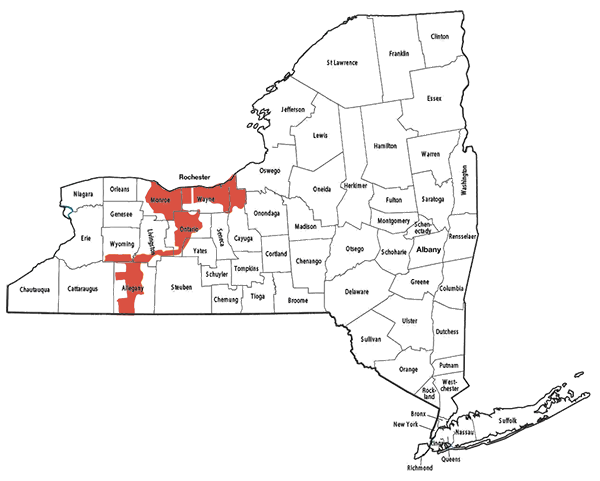
RG&E serves approximately 383,592 electricity customers and 317,661 natural gas customers across the following central New York counties:
| Allegany | Cayuga | Livingston | Monroe |
| Ontario | Wayne | Wyoming | |
RG&E serves the following cities:
What Is RG&E's Price to Compare (PTC)?
When New York deregulated its electricity market, utilities were required to divest their generating facilities and restrict operations to electricity distribution. The NY PSC simultaneously mandated that these utilities provide default electricity supply to customers who do not select an independent ESCO. To fulfill this obligation, RG&E procures electricity supply on the wholesale market and passes those costs through to customers without markup. This default supply rate is referred to as the Price to Compare (PTC).
How the RG&E PTC Rate Is Calculated
The PTC represents the full procurement cost of electricity encompassing both the generator's production cost and the expense of transmitting power over high-voltage transmission lines to RG&E's local substations, from which it is distributed through the local grid to customers' homes.
RG&E's PTC is primarily composed of the Supply Charge, a rate based on prevailing wholesale market conditions during each billing period. Additional components including the Merchant Function Charge, the Clean Energy Standard Supply Surcharge, and the Electricity Supply Reconciliation Mechanism are also incorporated into the monthly supply rate.
Because electricity demand fluctuates with seasonal conditions, the PTC rate is adjusted on a monthly basis. Rates may be lower during mild weather months and significantly higher during periods of peak demand, particularly in summer when air conditioning usage increases substantially. This inherent variability is a primary factor many customers consider when evaluating fixed-rate plans offered by retail energy suppliers.
RG&E Current PTC Standard Residential Rate:
- 10.750 cents per kWh, expires
How to Start New RG&E Electric Service
Establishing new service with RG&E is a straightforward process. Customers may visit the RG&E website to apply for electric service online. New users will need to create an account and follow the prompts to complete the application. Customers who prefer to speak with a representative may contact RG&E customer service directly at 1-800-743-2110.
The following information will be required at the time of application:
- Service Address: The address at which service is to be established or transferred.
- Service Start Date: The requested date for electricity service to begin.
- Personal Identification: A valid government-issued ID or credit card to verify identity and prior address. Applicants who cannot provide identification may be required to pay a security deposit.
- Proof of Occupancy: RG&E may request a copy of a lease agreement or property deed to confirm the applicant's occupancy date.
Applicants with outstanding balances from a prior RG&E account must pay those amounts in full or enter into a deferred-payment arrangement before a new account may be opened. If an application is denied, RG&E will issue written notification within three business days, including the specific reason(s) for denial and the steps required for approval.
RG&E Security Deposit Requirements
Under New York law, utilities may not require a security deposit as a condition of service for new residential customers. This protection also applies to customers aged 62 and older, as well as those receiving public assistance.
A deposit may, however, be required in the following circumstances:
- The applicant is a new seasonal or short-term customer.
- The applicant is opening a new account within 60 days of closing a prior account, the most recent bill (issued on a two-month cycle) is 50 or more days past due, and less than half the outstanding balance has been paid.
- Service was disconnected within the preceding six months.
Note: Customers aged 62 or older, or those receiving public assistance, supplemental security income, or additional state payments, are exempt from security deposit requirements.
When a deposit is required, RG&E must provide written notification within three business days specifying the reason. New York law limits deposits to no more than an estimated two months of usage charges. Customers have 20 days from the date of notification to remit payment, with the option to pay in installments over a 12-month period. Deposits held for residential service accrue interest when the customer maintains a consistent record of full, on-time payments for 12 consecutive months.
New York Energy Choice: Selecting an RG&E Electricity Supplier
Under New York's deregulated electricity market, residential customers have the right to purchase electricity supply from licensed Energy Service Companies (ESCOs) rather than defaulting to RG&E's PTC rate. ESCOs procure electricity on the wholesale market and offer retail plans at rates that are not regulated by the NY PSC and do not include the supply surcharges embedded in the PTC. This competitive structure enables ESCOs to offer fixed-rate plans across a range of contract terms.
Retail electricity plans in New York are available in two primary formats:
RG&E Customer Service: Billing, Outages, and Emergencies
Customers experiencing issues with their RG&E service should contact the appropriate department based on the nature of their inquiry.
RG&E Billing Assistance
For general billing inquiries, contact RG&E Customer Service at 1-800-743-2110. Customers experiencing difficulty paying their monthly bill should contact the RG&E Bill Payment Center at 1-888-315-1755 with their account number available. Payment arrangements and assistance program enrollment are also available through the RG&E online account portal.
The following billing options are available to RG&E residential customers:
- Budget Billing: As required by the NY PSC, RG&E offers budget billing, which distributes estimated annual electricity costs evenly across 12 monthly payments. This prevents unexpected high bills during periods of peak seasonal usage.
- One Less Worry Program: If the customer or a member of their household is hospitalized, this program can place the account's bill on hold for up to 30 days.
RG&E Power Outages and Emergencies
All downed power lines must be treated as energized and extremely hazardous. Never attempt to handle or move a downed power line. Call 911 immediately and then notify RG&E.
- To report downed power lines or electrical hazards, contact RG&E at 1-800-743-1701.
- If a natural gas leak is suspected or a gas odor is detected, evacuate the premises immediately and call RG&E at 1-800-743-1702 or 911 from a safe location away from the building.
- Outages may also be reported directly through the RG&E website.
- Customers can monitor active restoration efforts using RG&E's online outage map.
Electricity Usage and Your RG&E Bill
Electricity consumption patterns vary by household, but seasonal weather is consistently the largest driver of usage fluctuations for upstate New York customers. Cold winters and hot, humid summers generate significant swings in monthly energy demand, while year-round activities such as cooking, laundry, and general appliance use contribute to the baseline load.
- The majority of New York homes use natural gas as the primary heating fuel; only approximately 12.2% of state households rely on electricity for space heating.
- New York residents spend an average of 5% of their annual energy expenditure on air conditioning. Approximately 53% of New York households use window or wall-mounted air conditioning units, while 20% have central air conditioning systems.
- Approximately 32% of residential electricity consumption is attributable to electronics, lighting, appliances, and air conditioning.
- The remaining electricity usage is distributed among water heating, refrigeration, clothes drying, cooking, and small appliances.
Monitoring Your RG&E Energy Usage: RG&E customers may access up to 12 months of electricity usage data on each monthly bill or through their online account portal.
The most effective method for reducing monthly electricity costs is to lower overall energy consumption. Weatherization measures including sealing doors and windows, adding attic insulation, insulating the basement, and installing a programmable or smart thermostat can yield measurable reductions in energy use throughout the year. RG&E provides a range of customer resources and utility-sponsored programs to assist customers in improving their home's energy efficiency.
How to Read Your RG&E Electric Bill
A standard RG&E bill runs approximately five pages and contains multiple sections that, while comprehensive, can be difficult to interpret without guidance. The following summary explains the key components of a standard residential RG&E bill.
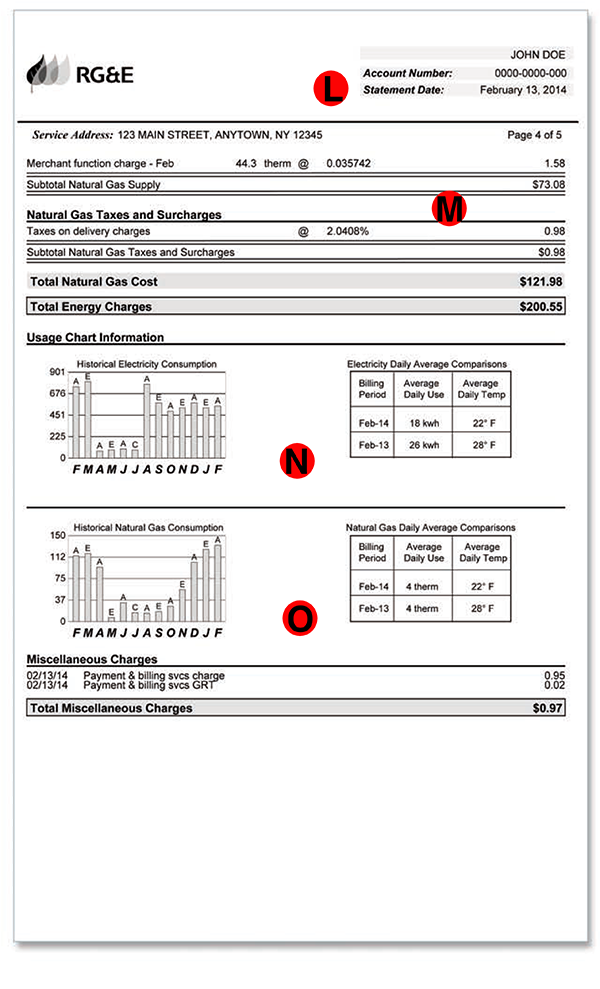
RG&E Sample Bill
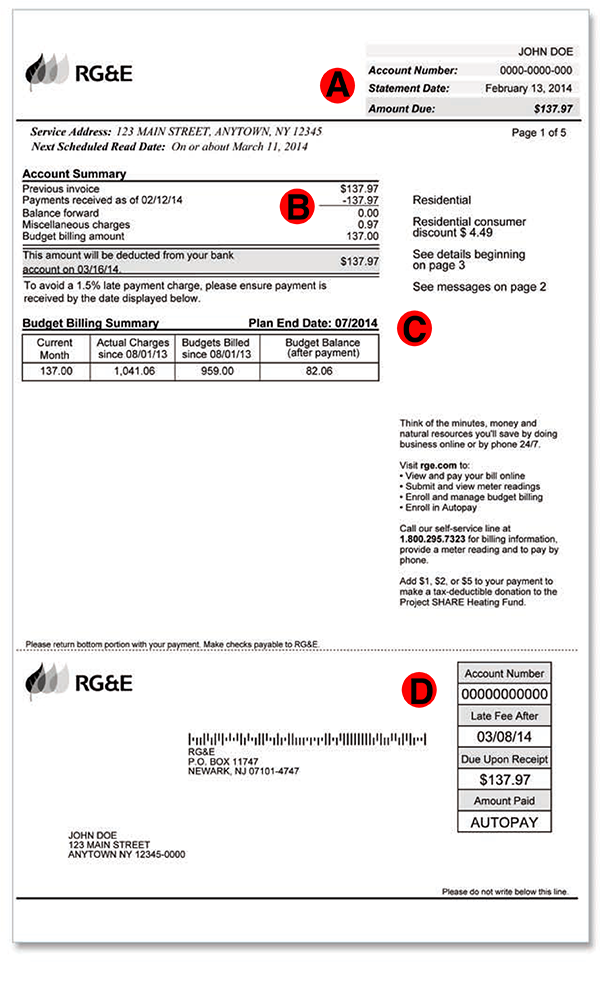
- A: Name, Account Number, and Statement Date. Displays the customer's name, 11-digit RG&E account number, the statement date, and the total amount due.
- B: Account Summary. Itemizes previous charges, payments received, any balance carried forward, and current charges for the billing period.
- C: Budget Billing Summary. For customers enrolled in Budget Billing, this section provides a breakdown of the current year-to-date balance. Budget Billing customers pay a consistent amount for 11 months of the year.
- D: Pay Stub. Displays the service address and the mailing address for check payments. Also shows the customer's account number, the total amount due for the current billing period, and the date after which late charges will apply if payment has not been received.
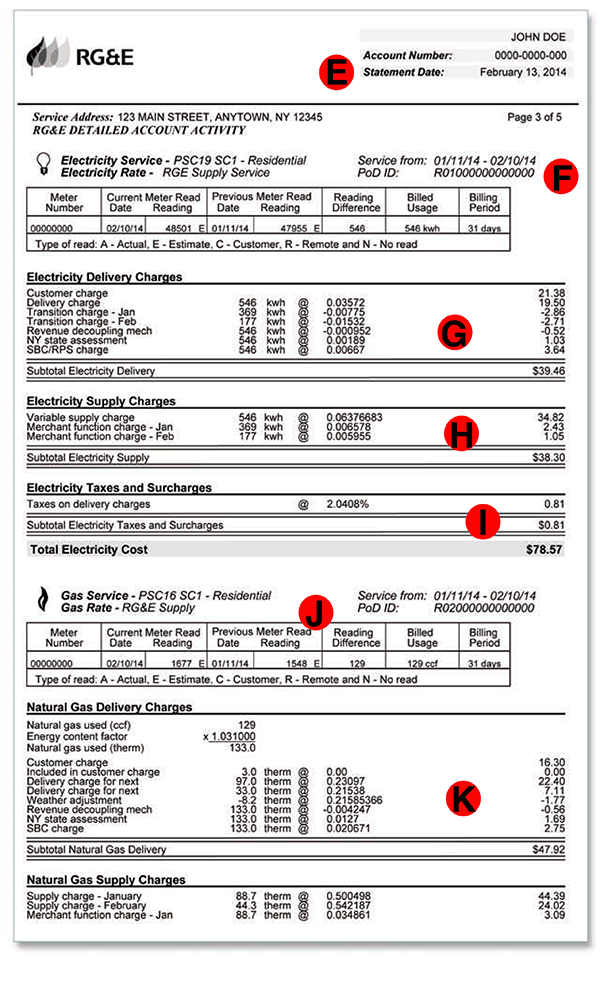
- E: Page 3 Name, Account Number, and Statement Date. Identifying information is repeated at the top of each bill page for reference. Page 3 covers monthly usage details; electricity sections are indicated by a light bulb icon, and natural gas sections by a flame icon.
- F: Electricity Service and Account Activity. Shows the service type and applicable rate code (residential rates are designated "SC1"), the service dates for the billing period (typically 30 days), and the customer's Point of Delivery (POD) number which must be provided to a retail supplier when shopping for an electricity plan. Also displays meter information, including current and previous readings, read dates, and total kWh consumed.
- G: Electricity Delivery Charges. Itemizes RG&E's delivery charge components, including the customer charge, per-kWh delivery charge, transition charge, and any applicable rider surcharges approved by the New York PSC.
- H: Electricity Supply Charges. Details the cost of electricity supply either at RG&E's default PTC rate or, for customers who have enrolled with an ESCO, at the terms of their retail supply agreement.
- I: Electricity Taxes and Surcharges. Lists applicable taxes and additional surcharges assessed on the electricity portion of the bill.
- J: Natural Gas Service and Account Activity. RG&E also delivers natural gas and provides default natural gas supply service. Customers may choose to purchase supply from an independent natural gas supplier. Usage is measured in hundred cubic feet (CCF).
- K: Natural Gas Delivery Charges. Displays the delivery charges assessed per hundred cubic feet (CCF) of natural gas consumed during the billing period.
- L: Page 5 Name, Account Number, and Statement Date. This page provides a summary of annual and current monthly electricity and natural gas usage and associated charges.
- M: Natural Gas Supply Charges. Details the cost of natural gas supply either at RG&E's default PTC rate or, for customers who have enrolled with an alternative gas supplier, at the terms of their retail supply agreement.
- N: Electricity Usage Chart. Displays the customer's electricity consumption for the past 12 months, allowing comparison of the current period with the same period in the prior year.
- O: Natural Gas Usage Chart. Displays the customer's natural gas consumption for the past 12 months, with a corresponding year-over-year comparison.
RG&E Delivery Charges vs. Supply Charges
RG&E residential customers are billed separately for electricity delivery and electricity supply. Understanding the distinction between these two charge types is essential to evaluating your bill and comparing rates effectively.
Ready to choose your energy rate?
Enter your ZIP code to explore the best energy plans in your area. Compare energy rates side by side, and choose the one that fits your home and budget.