Compare the Best National Grid Energy Rates
Find the lowest National Grid rates.
Select a Service Type and Enter Your ZIP Code to Get Started

Rated 5/5
Based on over 41,000 reviews
40%
Save up to 40%

100+
Electricity Providers

40+
Natural Gas Providers
National Grid Service Territory
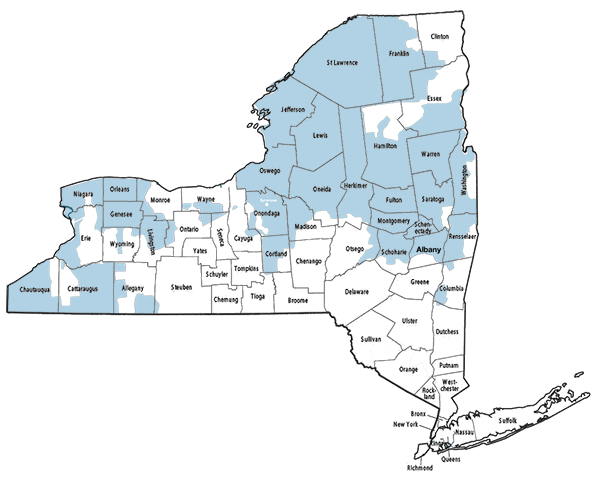
National Grid serves 1.6 million electric customers across more than 450 cities and towns in upstate New York. The utility holds franchise rights in some or all of the following counties:
| Albany | Allegany | Cattaraugus | Cayuga | Chautauqua |
| Chenango | Clinton | Columbia | Cortland | Erie |
| Essex | Franklin | Fulton | Genesee | Hamilton |
| Herkimer | Jefferson | Lewis | Livingston | Madison |
| Monroe | Niagara | Oneida | Onondaga | Ontario |
| Orleans | Otsego | Rensselaer | Saratoga | Schenectady |
| Schoharie | St. Lawrence | Warren | Washington | Wyoming |
National Grid serves these major cities:
What Is the National Grid Price to Compare (PTC)?
When New York deregulated its electricity market, utilities were required to sell off their power generation assets. However, the NY PSC also required those utilities to continue offering a default electricity supply rate to any customer who chooses not to shop for a retail supplier. That default rate is called the Price to Compare, or PTC.
The PTC reflects the actual cost National Grid pays on the wholesale market to purchase electricity on behalf of default-rate customers. It includes the cost of generating the electricity as well as the cost of transmitting it from power stations over high-voltage lines to National Grid's local distribution network. The NY PSC oversees this rate and requires that it be passed through to customers without markup.
How the PTC Rate Is Structured
The PTC is not a single static number. It changes monthly based on wholesale market conditions and varies by load zone. In addition to the base supply charge, your PTC bill may include the Merchant Function Charge, the Clean Energy Standard Supply Surcharge, the Electricity Supply Reconciliation Mechanism, and other state-mandated riders.
Because electricity demand rises and falls with the seasons, the supply charge can shift significantly from month to month. Summer months, when air conditioning drives peak demand, often carry the highest rates. Customers on the PTC have no way to lock in a rate or predict exactly what they will pay from one billing period to the next.
National Grid Current PTC Standard Residential Rates:
- 7.430 cents per kWh, Zone A, expires
- 7.430 cents per kWh, Zone C, expires
- 7.430 cents per kWh, Zone E, expires
- 7.430 cents per kWh, Zone F, expires
How to Start National Grid Electric Service
Starting electricity service with National Grid in New York is a simple process. Visit the National Grid website to start, stop, or transfer service, or call customer service at 1-800-642-4272. Before you apply, have your service address, requested start date, and a valid government-issued ID ready. National Grid may also ask for proof of occupancy, such as a lease or deed. Most new accounts are activated within a few business days. If you have an outstanding balance from a prior National Grid account, it must be resolved before a new account can be opened. Enter your zip code above to compare electricity supplier rates once your service is active.
Before you apply, have the following ready:
- Service address: The address where you want service started or transferred.
- Start date: The date you need service to begin.
- Identification: A valid government-issued ID, such as a driver's license, to confirm your identity and prior address. Applicants who cannot provide identification will be required to pay a deposit.
- Proof of occupancy: National Grid may request a copy of your lease or deed to confirm your move-in date.
Any outstanding balance on a prior National Grid account must be paid in full, or a deferred-payment arrangement must be in place, before a new account can be opened. If your application is denied, National Grid will notify you by letter within three business days, including the specific reason for denial and the steps required for approval.
Will I Need to Pay a Deposit?
New York State law prohibits utilities from requiring a security deposit simply to establish new residential service. However, National Grid may require a deposit under certain circumstances.
- You are applying as a seasonal or short-term customer.
- You have made two or more late payments within the past 12 months, or you are experiencing documented financial hardship.
- Your service was previously disconnected, or you have unpaid energy bills from the preceding six months.
Exemption: Customers aged 62 or older, or those receiving public assistance, Supplemental Security Income (SSI), or additional state payments are not required to pay a deposit.
If a deposit is required, National Grid must notify you in writing within three business days with a specific explanation. New York law caps deposits at the equivalent of two months of estimated usage. Customers have 20 days from the date of notification to pay, and the deposit may be paid in installments over 12 months. If a customer pays their bill in full and on time for 12 consecutive months, the deposit earns interest and is applied to the account.
Contact National Grid: Billing, Outages, and Emergencies
Billing Problems and Payment Assistance
The NY PSC requires all New York utilities to offer budget billing, which spreads your estimated annual electricity costs evenly across 12 monthly payments to prevent large seasonal spikes. If you are having difficulty paying your bill, contact National Grid before your account becomes overdue.
- National Grid Customer Service: 1-800-642-4272. Have your account number ready when you call.
- Customers who need more time to pay can request a payment extension online through their National Grid account or by calling customer service.
Power Outages and Safety Emergencies
All downed power lines are extremely dangerous. Never attempt to move or approach a downed line. Call 911 first, then contact National Grid.
- Report downed lines and safety hazards: 1-800-867-5222
- Outages can also be reported through the National Grid website.
- Track active outages and restoration progress on the National Grid outage map.
Other Common Questions from New York Electricity Shoppers
Who sends me my bill? National Grid sends a single consolidated bill that includes both delivery charges and supply charges, whether those supply charges come from National Grid or a retail ESCO.
What should I look for in the Terms of Service? In New York, all Customer Choice Plans must include a Terms of Service document that clearly identifies all charges, fees, and contract conditions. Terms vary from one supplier to the next, so reading the Terms of Service and the contract summary before enrolling is essential.
What is the Right of Rescission? Under the New York ESCO Consumer Bill of Rights, residential customers have the right to cancel an agreement with a retail supplier within three business days of receiving the signed agreement, with no penalty.
What are early termination fees? If you switch suppliers or cancel a fixed-rate plan before the contract term ends, you may be charged an early termination fee. These fees vary by supplier and plan, and they can be substantial. Always confirm the termination fee amount before signing up for any fixed-rate contract.
How do I access my usage history? National Grid customers can request up to 24 months of detailed usage data through their online account at no charge. This information is useful for comparing plan costs and tracking your consumption patterns over time.
Understanding Your National Grid Bill
A National Grid electric bill contains more information than most customers realize. Here is a section-by-section breakdown of what each part of the bill means.
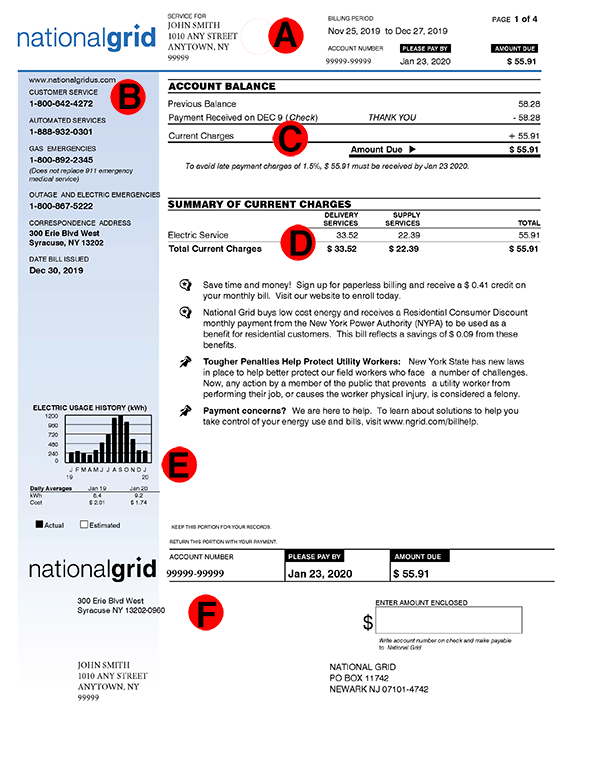
- A: Billing Information. Your name, 10-digit National Grid account number, service address, payment due date, and total amount due.
- B: Contact Information and Bill Date. National Grid contact numbers for customer service, emergencies, and outages, along with the date the bill was issued.
- C: Account Balance Summary. Your previous balance, payments received since the last bill, and the current charges for this billing period.
- D: Summary of Current Charges. A line-item breakdown of delivery charges and supply charges for the current period.
- E: Electric Usage History. Your monthly electricity consumption for the past 12 months, with a comparison to the same period in the prior year.
- F: Payment Stub. Your account number, bill due date, and amount due. The lower portion shows the mailing address for customers who pay by check.
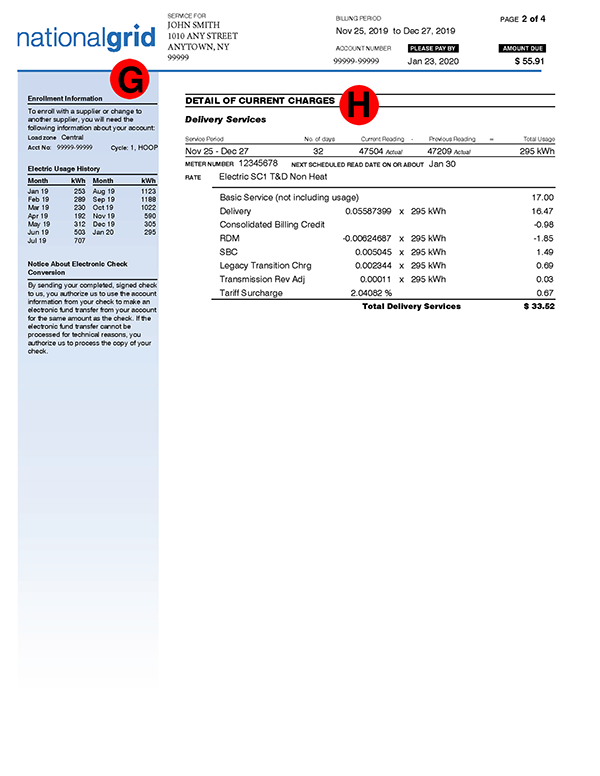
- G: Enrollment Information (Page 2). Your load zone, 10-digit account number, and billing cycle. This section also includes a month-by-month usage chart for the past year, which is helpful for budgeting. You will need this information when enrolling with a retail electricity supplier.
- H: Delivery Charges Detail. A full breakdown of your electricity delivery charges for the billing period, including rate type, basic service charge, per-kWh delivery charges, and any applicable surcharges. This section also shows your next scheduled meter-reading date.
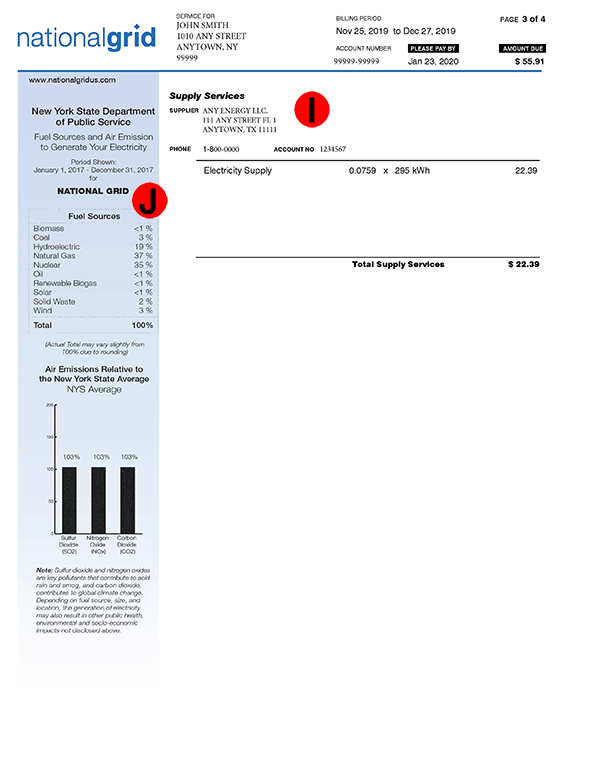
- I: Electricity Supplier Charges (Page 3). If you have enrolled with a retail supplier, this section shows the supplier's name and contact information, your consumption during the billing period, the rate in cents per kWh, and the total supply charge for the month.
- J: Fuel Mix and Emissions. A breakdown of the generation sources used to produce your electricity during the billing period. In New York, natural gas, nuclear, and hydroelectric generation account for the majority of electricity production.
National Grid Delivery and Supply Charges Explained
Your National Grid electric bill is made up of two distinct types of charges: delivery and supply. Understanding the difference helps you shop more effectively.
- Delivery Charges are regulated fixed-rate tariffs that cover the cost of transmitting electricity to your home through National Grid's local infrastructure. These charges fund the maintenance of power lines, substations, and meters, and they include smaller usage-based riders that support state-mandated programs. Delivery rates are set and approved by the New York Public Service Commission (NY PSC) and are the same for all National Grid customers regardless of which electricity supplier they use.
- Supply Charges represent the cost of the electricity itself, based on how many kilowatt-hours you consume in a billing period. National Grid customers can receive supply at the utility's default "Price to Compare" (PTC) rate, or they can choose a licensed retail energy supplier through New York's Energy Choice program and potentially pay a different rate.
Ready to choose your energy rate?
Enter your ZIP code to explore the best energy plans in your area. Compare energy rates side by side, and choose the one that fits your home and budget.